Tuesday, January 29, 2008

Shel Silverstien: The Great Smoke Off

Shel Silverstien
The Great Smoke Off
First appeared as a poem in Playboy in 1978

Now, in the laid-back California town of sunny San Rafael
Lived a girl named Pearly Sweetcake - you probably knew her well
She was stoned 15 of her 18 years, and her story was widely told
That she could smoke 'em faster than anyone could roll

Well, her legend finally reached New York, that Grove Street walk-up flat
Where dwelt the Calistoga Kid, a beatnik from the past
He'd been rollin' dope since time began, now he took a cultured toke
And said, "Jim, I can roll 'em faster than any CHICK can smoke"

So a note gets sent to San Rafael for the championship of the world
The Kid demands a smoke-off; "Well bring him on!" says Pearl
"I'll grind his fingers off his hands! He'll roll until he drops!"
Says Calistog, "I'll smoke that chick till she blows up and pops".

So they rent out Yankee Stadium, and the word is quickly spread
Come one, come all, who walk or crawl, tickets just two lids a head
And from every town and hamlet, over land and sea they speed
The world's greatest dopers, with the world's greatest weed.

Hashishers from Morocco, hemp smokers from Peru
And the Shashniks from Bagun (who smoke the deadly Pu-ga-ru)
And those who call it "light of life"
And those that call it "boo".

See the dealers and their ladies, wearing turquoise lace and leather
See the narcos and the closet smokers, puffing all together
From the teenies who smoke legal, to the ones who've done some time
To the old man who smoked "reefer", back before it was a crime.

And the grand old House That Ruth Built is filled with the smokes and cries
Of 50,000 screaming heads, all stoned out of their minds
And they play the national anthem, and the crowd lets out a roar
As the spotlight hits the kid and Pearl, ready for their smoking war.

At a table piled up high with grass, as high as a mountain peak
Just tops and buds of the rarest flowers, not one stem, branch or seed
I mean, Maui Wowie, Panama Red, Acapulco Gold
Kif from East Afghanistan, and that rare Alaska Cold

And there's sticks from Thailand, ganj from the island,
And Bangkok's blooming best
(and some of that wet imported $hit That capsized off Key West).

There's Oaxacan tops and Kenya bhang, and Riviera fleurs
And that rare Manhattan Silver, that grows down in the New York sewers.
And there's bubblin' ice cold lemonade, and sweet grapes by the bunches
And there's Hershey bars and Oreos (in case anybody gets the munches)

And the Calistoga Kid, he smiles,
And Pearly, she just grins
And the drums roll low, and the crowd yells "GO GO GO!!"
And the world's first smoke-off begins.

Well, the kid he flicks his fingers once, and ZAP that first joint's rolled
Pearl takes one toke with her famous lungs, and WHOOSH that roach is cold
Then the kid he rolls his super-bomb, that would paralyze a moose
And Pearl takes one mighty hit, and ...... that bomb's defused

And then he rolls three in just ten seconds, and she smokes them up in nine
And everybody sits back and says, "Hey.... this just might take some time"

See the blur of flying fingers, see the red coal burning bright
As the night turns into mornin', and the mornin' fades to night
And the autumn turns to summer, and a whole damn year is gone
And the two still sit, on that roach-filled stage, smokin', and rollin'...on

With tremblin' hands he rolls his jays, with fingers blue and stiff
She coughs and stares with bloodshot gaze, and puffs through blistered lips
And as she reaches out her hand for another stick of gold
The Kid, he gasps, "Damn it, *****! There's nothin' left to roll!"

"NOTHIN' LEFT TO ROLL!" screams Pearl. "IS THIS SOME TWISTED JOKE?
I DIDN'T COME HERE TO **** AROUND; MAN, I COME HERE TO SMOKE!"

And she reaches 'cross the table and grabs his bony sleeves
And crumbles his body between her hands, like dried and brittle leaves
Flicking out his teeth and bones like useless stems and seeds
And then she rolls him in a zig-zag, and lights him like a roach
And the fastest man, with the fastest hands, goes up in a puff of smoke.

In the laid-back California town of sunny San Rafael
Lives a girl named Pearly Sweetcake - you probably know her well
She been stoned 21 of her 24 years, and her story is still widely told
How she still can smoke 'em faster than any dude can roll

While, off in New York City, on a street that has no name
There's the hands of the Calistoga kid, in the Viper Hall of Fame
And underneath his fingers, there's a little golden scroll
That says, "Beware of bein' the roller
When there's nothin' left to roll".

http://www.gaianbotanicals.com/


Thursday, January 24, 2008

magic mushrooms and the sixties

Continued from: The Mushroom Gods

After their discovery in 1955, magic mushrooms remained the domain of middle-class botanists and adventurers who hightailed it to Mexico to follow R Gordon Wasson's trail

Meanwhile, Swiss biochemist Albert Hoffman, the creator of LSD, was studying the mushrooms in his lab and was soon to isolate the stable active ingredient, psilocybin.

By 1958 his company Sandoz were sending out little pink pills of psilocybin to curious psychologists and therapists all over the world.

The high priest
One such package arrived on the doorstep of Harvard psychology professor Timothy Leary.

He soon became convinced that psilocybin (and later, LSD) presented an opportunity to map the uncharted frontiers of the mind. Over a 15-month period, he conducted a series of experiments into the psychedelic state.

Some were indulgent, some uneventful, some frankly rubbish. Some though, like the Good Friday experiment, revealed some interesting insights.

the good friday experiment
The setting was Boston University's Marsh Chapel. Leary and co divided 20 theology students into five groups of four. Half were given psilocybin, and the rest were given a placebo of nicotinic acid, which causes facial flushes, nothing else. It was a double blind study - neither the students nor the ex-school teachers who asked the 147-part questionnaire after the experiment knew who had been given what. Within an hour, though, it was pretty clear:

"While half sat attentively listening to the Easter service that was being piped in from the main chapel, the others were all over the place, lying on benches moaning, or wandering around fixating on the various religious icons. One sat at an organ, playing weird, exciting chords." (from Storming Heaven by Jay Stevens)

Of the 10 who downed the nicotinic acid, only one reported anything close to a religious experience. Of the 10 who took psilocybin, nine reported having a mystical experience.

turn on, tune in, drop out
Unfortunately, the "miracle of Marsh Chapel" finally broke Harvard's patience. Leary was soon sacked and, with his catchy mantra: "Turn on, tune in, drop out", spearheaded a psychedelic-soaked counter-culture revolution in 60's America. It would culminate in the Summer Of Love in 1967, and then go rapidly pear-shaped with media hysteria, Leary's arrest, and the banning of psilocybin (along with LSD) in 1968.

From: thegooddrugsguide.com

Tuesday, January 22, 2008

Futureprimitive.org - RAPTURE & REVOLUTION

More great interviews on futureprimitive.org

A new series of five discussions beginning 29 December 2007 between Joanna Harcourt-Smith and John Lash on Entheogens and the Planetary Shift entitled Rapture & Revolution

Rapture and Revolution- first of five talks
Saturday, December 29th, 2007
The first in the series of five talks with John Lash on Entheogens and the Planetary Shift. The first talk deals with the Wasson thesis and the religious view of nature.
Rapture & Revolution discussion 1 [45:06m]
Download: The Wasson Thesis and the Religious View of Nature

The Psychonautic Adventure - Three Generations of Discovery
Wednesday, January 2nd, 2008
The second in a series of five talks with John Lash on Entheogens and the Planetary Shift. The second talk deals with the psychonautic adventure.
Rapture & Revolution discussion 2 [39:20m]
Download: The Psychonautic Adventure - Three Generations of Discovery

The third in a series of five talks with John Lash on Entheogens and the Planetary Shift. The third talk deals with the Organic Light and Telestic Shamanism.
Rapture & Revolution discussion 3 [50:06 mins]

Addendum to The Organic Light and Telestic Shamanism
Monday, January 21st, 2008
Addendum to the third in a series of five talks with John Lash on Entheogens and the Planetary Shift. John clarifies certain points regarding the Organic Light and Telestic Shamanism.
Rapture & Revolution part two of discussion 3 [21:33m]
Download: Addendum to The Organic Light and Telestic Shamanism

The fourth in a series of five talks with John Lash on Entheogens and the Planetary Shift. The fourth talk deals with the Planetary Shift - Society or the Species
Rapture & Revolution discussion 4 [45:08m]

UPCOMING RAPTURE AND REVOLUTION TOPICS:
The Revolution and Evolution of Love

FuturePrimitive.org

Monday, January 21, 2008

the mushroom gods


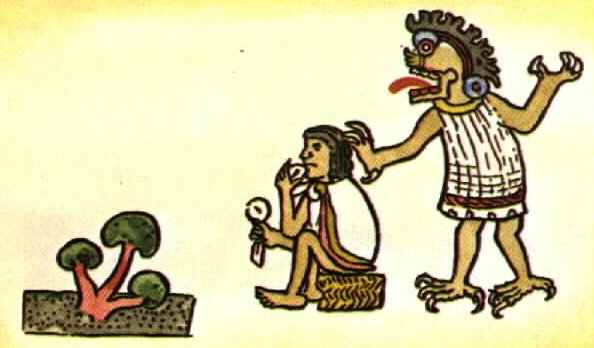
Psychedelic mushrooms have been around as long as humanity. The Incas called them teonanactl or 'flesh of the gods'. The Aztecs considered them divine and referred to a trip as "the flowery dream". Prehistoric Saharan tribes painted mushroom-headed figures on cave walls.

Siberian shamans fed their reindeers fly agaric mushrooms and then drank their urine to journey to the spirit world. They would also drink each other's urine, and the mushroom could be passed through the bodies of half a dozen people before their potency was lost.


Aztec mushroom god

religion and ritual
The Central American tradition firmly encased sacred mushrooms in religion and ritual - in the kinds of ceremonies that evolved into today's (legal) peyote rituals of the Native American Church in the US. These rituals encourage spiritual development, expand the consciousness and enrich the soul.

bankers & shamen
Colonising Spaniads in the 16th century had brutally stamped out the 'satanic' mushroom rites of the indigenous South American peoples. For hundreds of years, the rites and rituals and even the mushrooms themselves were forgotten, thought lost. Until, that is, the unlikely figure of the vice-president of JP Morgan investment bank, R. Gordon Wasson, trundled into the Mexican highlands in 1954 and rediscovered them.

mycophiles
In the early 20th century, interest in botany and classification of species was rampant. Loads of moustachioed Victorians were out to catalogue the world. Ancient legends of a psychoactive mushrooms and a primitive 'mushroom cult' native to South America were unearthed. Several enthnobotanists and mushroom-lovers (mycophiles) made forays to Mexico and Peru to try to discover these holy shrooms. In their spare time, R. Gordon Wasson and his Russian wife Valentina were obsessive mushroom-lovers and had made it their life-quest to find the sacred mushrooms.


Maria Sabina: Mexican curandera

Wasson's first tripAfter years of field trips and false starts, they finally tracked down a 'curandera' or shaman in a mountainous Mexican village. Wasson was permitted to take part in the lengthy religious ceremony and was dosed with a sizeable handful of psyilcybin mexicana. In his own words:

"At the peak of the intoxication, about 1½ hours after ingestion of the mushrooms, the rush of interior pictures, mostly changing in shape and colour, reached such an alarming degree that I feared I would be torn into this whirlpool of form and colour and would dissolve."

life magazine
Wasson was amazed. Being a gentleman and pillar of the financial establishment, his report of the adventure was documented in Life magazine.

You can read the open minded and often hilarious piece here - a good example of literature untainted by drugs hysteria.

The magazine coined the snappy phrase "magic mushrooms" to describe his find.

The phrase would soon catch on...

The article caught the eye of the CIA who approached Wasson to find out whether the mushrooms had any potential military use. Wasson refused to help them so they smuggled an operative onto his next expedition.

But by then the mushrooms were attracted some new disciples...

Friday, January 18, 2008

Mormons Vs. Atheists

John Safran Mormons Vs. Atheists


John Safran Reveals the Secrets of
Legendary Latter-day Lingerie

Thursday, January 17, 2008

Ron Paul: Privacy and Personal Liberty


Privacy and Personal Liberty

The biggest threat to your privacy is the government. We must drastically limit the ability of government to collect and store data regarding citizens’ personal matters.

We must stop the move toward a national ID card system. All states are preparing to issue new driver’s licenses embedded with “standard identifier” data — a national ID. A national ID with new tracking technologies means we’re heading into an Orwellian world of no privacy. I voted against the Real ID Act in March of 2005.

To date, the privacy focus has been on identity theft. It was Congress that created this danger by mandating use of the standard identifier (currently your SSN) in the private sector. For example, banks use SSNs as customer account identifiers because the government requires it.

We must also protect medical privacy. Right now, you’re vulnerable. Under so-called “medical privacy protection” rules, insurance companies and other entities have access to your personal medical information.

Financial privacy? Right now depositing $10,000 or more in cash in your local bank account will generate a federally-mandated report to the Financial Crimes Enforcement Network at the United States Department of the Treasury.

And then there’s the so-called Patriot Act. As originally proposed, it:
  • Expanded the federal government’s ability to use wiretaps without judicial oversight;
  • Allowed nationwide search warrants non-specific to any given location, nor subject to any local judicial oversight;
  • Made it far easier for the government to monitor private internet usage;
  • Authorized “sneak and peek” warrants enabling federal authorities to search a person’s home, office, or personal property without that person’s knowledge; and
  • Required libraries and bookstores to turn over records of books read by their patrons.

I have fought this fight for many years. I sponsored a bill to overturn the Patriot Act and have won some victories, but today the threat to your liberty and privacy is very real. We need leadership at the top that will prevent Washington from centralizing power and private data about our lives.

http://www.ronpaul2008.com/

Wednesday, January 16, 2008

Program Yourself by Christopher Harris

'Program Yourself'

By Christopher Harris
From: iPlant.eu
Posted: Jan 12, 2008

What might happen when one can control their our own dopamine and serotonin levels via brain implants? Here is a short story describing one possible outcome, in which consciousness takes an unexpected evolutionary turn:

“Most people don’t realize how common brain implants have become in the last couple of years. Every month thousands of patients all over the world have electronics surgically implanted into their heads to treat problems with hearing, movement and pain, and more recently with epilepsy, vision, paralysis, depresssion, compulsive behaviour and loss of consciousness (Perlmutter & Mink, 2006; Lebedev & Licolelis, 2006; Kringelbach et al, 2007). The iPlant is just another implant, aimed at new regions in the brain.”...

“All eight implants also regulate baseline or so called ‘tonic’ electrical activity in their target cells. For dopamine we call this program Focus. People perform best when their dopamine concentrations are at an optimum level for the task at hand and most of us experience daily problems maintaining sufficient dopamine levels; maintaining concentration. Focus works similarly to the stimulants children are prescribed for ADHD, but it’s cleaner and more flexible and can be turned off, which means fewer side effects. The analogous program for serotonin we call AntiDep because it works like SSRI antidepressants. If you’re depressed or chronically anxious, chances are you were born with an underdeveloped serotonin system or its growth was stunted by stress (Jans et al, 2007). Like antidepressants, AntiDep prevents some of the more vicious long-term effects of not having enough serotonin, like overproduction of stress hormones, inhibited growth in the hippocampus, and, at least for some people, social isolation and despair (Dranovsky & Hen, 2006).”...

Tuesday, January 15, 2008

Dr Rupert Sheldrake - Paranormal Science

From Chris Brauer Media Project
Paranormal Science

You can tell by the way he theatrically rolls up his sleeves when finished the lecture and ready for questions. He secretly loves the controversy.

Two men in crumpled jackets settle deep in their chairs in the third row and can be overheard: "we've come to refute him". A young couple playfully join in the fun near the back: "Am I staring at you? ... Yes? ... No? ... Am I staring at you? ... Yes? ... No?"

Enter the world of Morphic Resonance -- the theory that all species draw upon a collective memory -- and you enter the world of Dr Rupert Sheldrake, a biologist with a bulging academic resume and one of the world's most influential paranormal researchers.

The basic theory follows up on Carl Jung's notion of a collective unconscious, but extends it beyond humans to all living matter. Dr Sheldrake believes that memory is inherent in nature and that the brain emits morphic fields of mental activity, not unlike the way magnetic or gravitational fields extend out from the surface of objects. The fields of our minds extend out from our brains and we are in constant contact with the sum of all this activity, we simply don't often recognize it.

Through morphic resonance, the patterns of activity in self-organizing systems are influenced by similar patterns in the past, giving each species and each kind of self-organizing system a collective memory. This memory manifests itself in habits, not laws which are inherently human, and a natural selection of habits occurs over time resulting in not just biological but social, cultural, mental and cosmic evolution.

Dr Sheldrake's rigorous intellectual defense of these theories, most recently in a convened session at Goldsmiths College, University of London as part of the Whitehead Lectures on Cognition, Computation and Creativity, makes it more difficult to dismiss than traditional paranormal fare. Tune into his debate with Professor Lewis Wolpert at the Royal Society of the Arts in 2004 for a sample and see if you'd like to go head-to-head with the Harvard/Cambridge scholar.

But a lot of resistance remains to the metaphysical, not traditionally scientific, grounding of Morphic Resonance. Probably the most famous scientific application has been Dr Sheldrake's studies of people being stared at and how we are aware of this phenomena without traditional sensory input.

He finishes his Whitehead lecture giving a robust history of western thought from the greeks to present. His description of global scientific/philosophical history is engaging and descriptive. The world is in the midst of a huge clash between the "two tectonic plates" of understanding, those who see the world as always changing and those who see it as always staying the same. "Every government in the world" has followed on Thomas Hobbes and self-interested cooperation. A few hands dart up and others are more slowly raised from the audience of assembled academics.

"So you obviously don't believe in life on other planets or surely we would know all they know through morphic resonance and would therefore have nothing to learn?"

"Very good question." ... Rupert Sheldrake takes off his jacket and rolls up his sleeves ...

Saturday, January 12, 2008

Ebook: The Free iPod Book 3.0

The Free iPod Book 3.0, by iLounge.com

The iPod and iTunes tutorial has returned for its third edition and as always, it’s free!

image
Single page, best for printing (18 MB PDF)


image
Double page, best for monitors (18 MB PDF)

To save to disk, right-click and save.
Requires Adobe Acrobat Reader 5.0 or later.

What will you find in the 230-page Free iPod Book 3.0? Here’s a quick summary:

Sneak Peeks: Over 20 exclusive iPod and iPhone accessories debut, including Ultimate Ears’ top-of-the-line, quadruple-driver UE-11s, V-moda’s VIBE Duo, Belkin’s awesome new Armband and Acrylic Cases for iPhone, Marware’s SportGrip Backwinder, and much, much more.

The All Things iPod Guide: Prepare to be amazed by your iPod all over again. As you read through the 15 sections of our latest iPod tutorial and accessories guide, you’ll find tips on customizing, buying, selling, and repairing iPods, our top accessory recommendations, and ways to create and acquire great iPod video, music, and gaming content.

iTunes Tips and Tricks: Now with over 140 tips, our massive iTunes tutorial helps you quickly understand all the best features of Apple’s digital media management software and online iTunes Store, including up-to-the-minute information on iTunes Plus downloads, Cover Flow, and much more.

The iPhone Index: Prepare for the release of Apple’s much-anticipated iPhone with this A-Z guide to its features, known specs, and issues.

Love Your Apple TV: Not sure what to make of the in-home media player that some have dubbed a screenless iPod? Our quick guide to Apple TV will help you wisely go from initial connection to creating superb content, and preparing for hardware and software upgrades.

Backstage and Closing the Curtain: See what iLounge’s editors used in the creation of the Book, and what sort of gadgets they’ve been playing with or lusting after in recent days. Also, a few pointers to Microsoft on helping to boost flagging sales of the “iPod killer” Zune.

All this, and much more, is available right here. For free, in PDF format, thanks to the support of 21 leading iPod accessory and software developers whose ads are clickable in the Book. Enjoy!

Friday, January 11, 2008

Andrew Weil: Psychoactive Drugs Through Human History

Dr. Andrew Weil:
Psychoactive Drugs Through Human History [1983]
From: The Psychedelic Salon Podcast Series
Download: Mp3 Format

NOTE: All quotes below are by Dr. Andrew Weil

04:41 "There are no good or bad drugs. Drugs are what we make of them. They have good and bad uses."

05:04 "I know of no culture in the world at present or any time in the past that has not been heavily involved with one or more psychoactive substances."

06:33 "Alcohol, any way you look at it, is the most toxic and most dangerous of all psychoactive drugs. In any sense, in terms of medical toxicity, behavioral toxicity, there is no other drug for which the association between crime and violence is so clear cut . . . and tobacco, in the form of cigarettes is THE most addictive of all drugs."

08:47 "What could be a more flagrant example of drug pushing than public support of that industry [tobacco and cigarettes]."

12:38 "I see a great failure in the world in general to distinguish between drug use and drug abuse."

16:25 "Another very common use, in all cultures, of psychoactive substances is to give people transcendent experiences. To allow them to transcend their human and ego boundaries to feel greater contact with the supernatural, or with the spiritual, or with the divine, however they phrase it in their terms."

17:54 "Drugs don’t have spiritual potential, human beings have spiritual potential. And it may be that we need techniques to move us in that direction, and the use of psychoactive drugs clearly is one path that has helped many people."

19:59 "Why is it that the human brain and plants should have the same chemicals in them?"

22:39 "The effects of drugs are as much dependent on expectation and setting, on set and setting, as they are on pharmacology. We shape the effects of drugs. All drugs do is make you feel temporarily different, physically and psychologically."

25:26 "The effects of drugs can be completely shaped by cultural expectations, by individual expectations, by setting as well."

28:22 "The manner of introducing a drug into the body is crucially determinant of the effects the people experience. And especially of its adverse effects, both short term and long term."

31:51 "I think it’s unfortunate that in this culture we have fallen so much into the habit of relying on refined, purified durative of plants, in highly concentrated form, both for recreational drugs and for medicine. And have formed the habit of thinking that this is somehow more scientific and effective, that botanical drugs are old-fashioned, unscientific, messy. In fact, they’re much safer, and sometimes the quality and effects are better."

32:55 "It’s we who determine whether drugs are destructive or whether they’re beneficial. It’s not any inherent property of drugs."

41:36 "The use of yage, or Ayahuasca, in Amazonian Indian cultures is often credited with giving people visions that have valid content."

50:25 "But I think healing, like religious experience, is an innate potential of the body. It’s not something that comes in a drug. All a drug can do is give you a push in a certain direction, and I think that even there expectation plays a great role in that."

Thursday, January 10, 2008

2012 apocalypticism and/or spiritual transformation

Theories of apocalypticism and/or spiritual transformation
From: 2012 The Red Pill

2012 (MMXII) is a leap year starting on Sunday of the Gregorian calendar. Several prophecies and legends project this year as when the end of the world or an evolutionary change in human consciousness will occur. It is also the end of the Maya calendar. The year 2012 in the Gregorian Calendar corresponds to the years 5772 and 5773 in the Hebrew Calendar.

December 21 - End of the great cycle of the Maya calendar's Long Count and a 26,000 year planetary cycle in the Aztec calendar, and thus the alleged end of our world (the end of the cycle is dated December 22 or December 23 by some calculations).

According to the 1997 book The Bible Code the world will end due to a collision with a meteor, asteroid or comet.

Interpreted by Millennialism as a time when there will be an evolutionary change in human consciousness brought about by a series of world changing events or revelations. Following this period of upheaval they believe we will begin a new 1,000 year cycle in which peace, enlightenment and our environmental movement take priority.

The Olduvai cliff will begin and permanent blackouts will occur worldwide, according to "The Peak of World Oil Production and the Road To The Olduvai Gorge" by Richard C. Duncan.

Terence McKenna's Novelty Theory claims that time is a fractal wave of increasing novelty that ends abruptly in 2012.

Tibetan Monks specialising in remote viewing predict that divine extra-terrestrials will intervene at a point where the world's governments are about to deploy weapons of mass destruction. Adding to this, the Tibetan Monks say that the world is not ready to be destroyed and that our Earth is blessed and being saved continuously from all kinds of hazards that Mankind is not even aware of.

References
Drosnin, Michael. (1997) The Bible Code. New York, NY: Touchstone Press.

Retrieved from "http://redpill.dailygrail.com/wiki/2012"

Wednesday, January 9, 2008

ON/OFF/IN/OUT: The Leary District

Curbed SF SWL 337 Planning Challenge: First Runner Up REVEAL
by Sarah Hromack

Yesterday the Curbed SF SWL 337 Planning Challenge Runner Up award was awarded to Jackson West, for "The City That Once Knew How," a plan that featured aptly-named buildings like Bonds-by-the-Bay Tailgating Lounge and the Brown-Burton Memorial and Dog Fighting Pavilion. Today we're on to the First Runner Up award, which we'd like to hand over to reader Tim Halbur for his plan, "ON/OFF/IN/OUT: The Leary District." While we would lose all sense of ourselves if deprived of our MacBook/ iPhone for upwards of 5 minutes a couple of hours, we're happy to see that somebody's watching out for us. $125 coming right at you, Tim. From the intro:

The concept of the Leary District is taken from the infamous Timothy Leary quote, "Tune in, turn on, drop out." Except in this case, it isn't a directive- it's a choice. In the new all-digital world, it becomes increasingly difficult to find a public space that is non-digital to relax and be around people relating face-to-face. Likewise, the usefulness of free, accessible wifi, cell phones and Bluetooth in public are hard to ignore. The Leary District will create ON and OFF public spaces, with additional choices for IN and OUT, like a series of hot and cold pools at a spa.

· Curbed SF SWL 337 Planning Challenge: Runner Up REVEAL
· Curbed SWL 337 Planning Challenge: Pre-Reveal
· Curbed SF SWL 337 Planning Challenge: Giants Up the Ante
· Curban Planning: Enter the Curbed SF "SWL 337" Planning Challenge

The ON/IN Space will be designed to promote digital communication and accessibility. Free banks of plugs and wifi are accessible to all, and an ON website will feature forums that visitors can use to have online conversations. A central Jumbotron reflects polls taken online and feature videos created by users.

The ON/OUT Space has a similar wifi accessibility, but quiet searching and contemplation is suggested. A fountain creates a meditative wash of white noise. Cell phones are blocked.

The OFF/IN Space will be jammed on all signals- no digital communication is possible or allowed. Yet, face-to-face communication is encouraged. Open-air restaurants, a wine bar and a beer hall (properly separated, of course) create a lively atmosphere. Games, like a giant chess board and bocci ball, are available to all.

The OFF/OUT Space is quiet, contemplative, and completely non-digital. Yoga and meditation classes are given, but the emphasis is on creating a peaceful atmosphere with room for individual thought.

Surrounding mixed-uses are encouraged to adapt to their relation to the degrees of ON and IN in their public space, and renters and owners will, through natural selection, gravitate into the neighborhoods that suit their disposition.

While modern in thought and use, the architecture and style of the Leary District will mimic the beauty of the Mission Revival-style designs popular in Golden Gate Park and the Presidio. Landscaping will resemble the remarkable restoration work done in Chrissy Field, creating a harmonious balance to the public land on the opposite sides of the city. ON/OFF/IN/OUT: The Leary District