Showing posts with label Coca. Show all posts

Wednesday, February 15, 2012

Wade Davis: Why Ancient Wisdom Matters in the Modern World

Wade-Davis
Speaker:
Wade Davis
From:
The Long Now Foundation
Location: Cowell Theatre: San Francisco, CA
Download:
Mp3
Download:
PDF Transcript
Date: January 13, 2010

Anthropologist Wade Davis is one of the world's great story tellers, with personal adventures to match. An Explorer-in-Residence at National Geographic, he specializes in hanging out with traditional peoples and exploring their religious practices.

He first came to public notice with his discovery of the reality of zombies in Haitian voodoo and the substance used to poison them---chronicled in his 1985 book, The Serpent and the Rainbow. He is the author of 13 books, including One River and Shadows in the Suns, and has hosted, written, and starred in numerous television specials, including "Earthguide," "Light at the Edge of the World," "Spirit of the Mask," and "Forests Forever." This talk is based on the prestigious Massey Lectures that Davis gave in Canada in 2009.

W. Davis: Why Ancient Wisdom Matters in the Modern World from The Long Now Foundation on FORA.tv

Summary

What does it mean to be human and alive?

The thousands of different cultures and languages on Earth have compellingly different answers to that question. "We are a wildly imaginative and creative species," declares Wade Davis, and then proves it with his accounts and photographs of humanity plumbing the soul of culture, of psyche, and of landscape.

The threat to cultures is often ideological, Davis notes, such as when Mao whispered in the ear of the Dalai Lama that "all religion is poison," set about destroying Tibetan culture.

The genius of culture is the ability to survive in impossible conditions, Davis concludes. We cannot afford to lose any of that variety of skills, because we are not only impoverished without it, we are vulnerable without it.

www.GaianBotanicals.com


Wade Davis author of The Wayfinders at the 2009 Massey Lecture in the Convocation Hall, Toronto, October 31, 2009.

Wednesday, December 9, 2009

Czech government defines rules of legal drug possession

image

The cabinet was today also expected to discuss artificial drugs and a permitted amount of these drugs in people's possession.

However, it postponed the debate for two weeks, the source said.

The new Penal Code, which will take effect on January 1 is designed to specify the government's directive. It contains a special provision on the growth of hemp and magic mushrooms.

The government today also approved a directive on the use of anabolics and the list of diseases that will be considered congenial, according to the criminal law.

The law distinguishes between the possession of marijuana and hashish for people's personal needs, for which they will face up to one year in prison, from the possession of other drugs for which they can receive up to two years in prison.

According to the Justice Ministry's proposal that the government did not approve today, the possession of over 15 grams of dried marijuana or over two grams of methamphetamine (pervitine), cocaine and heroin will be punishable.

The tolerated amount of drugs in people's possession is at present defined by police internal directives. No one thus knows precisely what amount is considered an amount "larger than a small amount of drug," the possession of which is punishable by the law.

If the government approves the ministry's proposal without changes in two weeks, people will be able to have four pills of ecstasy in their possession and up to five grams of hashish.

Prague - The Czech government today approved the list of hallucinogenic plants and mushrooms, including hemp, coca, mescaline cactus and magic mushrooms, and decided that people would be allowed to grow up to five pieces of such plants and keep 40 magic mushrooms at home, a CTK source said.

From ČTK

Friday, May 29, 2009

The good old days of Medicine

Marijuana, Cocaine, Morphine, Heroin, Amphetamine and even LSD were once medically accepted and offered as miracle cures up until this past century. These same substances that are now illegal and stigmatized will send anyone in the possession of them to prison. During this period numerous pharmaceutical manufacturers proudly proclaimed that their products contained these and other drugs. Below are a some interesting examples of these medicines.


Cocaine based Medicine
Cocaine was sold over-the-counter until 1914. It was widely used in tonics, toothache cures, patent medicines, and chocolate cocaine tablets. Prospective buyers were advised (in the words of the pharmaceutical company Parke-Davis) that cocaine "could make the coward brave, the silent eloquent, and render the sufferer insensitive to pain".


Cocaine toothache drops (circa 1885) were popular for children.
Not only would the medicine numb the pain, but it could also put the user in a "better" mood.


Metcalf's Coca Wine was one of a large number of cocaine-containing wines available on the market. All claimed medicinal effects, although they were undoubtedly consumed for their "recreational" value as well.


Vin Mariani (Circa 1865) was the leading Coca Wine of its time. Pope Leo XIII reportedly carried a hipflask of Vin Mariani with him.
CocaPope
His Holiness even awarded a Vatican gold medal to its creator, Angelo Mariani.


This coca wine was made by the Maltine Manufacturing Company (New York). The dosage indicated on the back of the bottle reads: "A wine glass full with, or immediately after, meals. Children in proportion."


Cocaine-containing throat lozenges (circa 1900) were "indispensable for singers, teachers, and orators." In addition to quieting a sore throat, these lozenges undoubtedly provided the "pick-me-up" to keep these professionals performing at their peak.


A paperweight advertisement for C.F. Boehringer & Soehne (Mannheim, Germany), "largest makers in the world of quinine and cocaine." This chemical manufacturer was proud of its leading position in the world's cocaine market.


Opiate based Medicine
formulations containing Opiates were probably even more widely employed than those containing cocaine. Laudanum had been in use for over two centuries, and the isolation of morphine in the early 19th century and the later development of heroin were lauded as even more effective remedies.

Modern authors usually suggest that widespread opium use was a major health problem during the 19th century. However, the use of opiates must be kept in proper perspective with other contemporary health problems. Mortality from cholera, malaria, and dysentery was very high, and opiates provided some relief from these illnesses (Opiates remain the most effective treatment for dysentery.). Some authors have suggested that the easy availability of opiate-based medicines saved more lives than it took. As the deleterious effects of chronic opiate use became increasingly recognized during the late 19th century, several factors helped ease the need for opiates: the improvements in sanitation diminished cholera and dysentery, the drainage of swamp lands decreased malaria, and the introduction of acetylsalicylic acid (aspirin; 1899) provided an alternative medicine for moderate pain relief.


This bottle of Stickney and Poor's paregoric (mixture of opium and alcohol) was distributed much like the spices for which the company is better known. Doses for infants, children, and adults are given on the bottle. At 46% alcohol, this product is 92 proof which is pretty potent in itself.


Bayer Heroin bottle. Up until 1910 heroin was marketed as a non-addictive morphine substitute and cough medicine for children! Heroin became it illegal to manufacture in 1924.


This ad is for Glyco-Heroin manufactured by Martin H. Smith Company (New York). Heroin was widely used not only as an analgesic but also as a remedy for asthma, coughs, and pneumonia. Mixing heroin with glycerin (and often adding sugar or spices) made the bitter-tasting opiate more palatable for oral consumption.


This National Vaporizer Vapor-OL (opium) Treatment no. 6 for asthma may have provided a unique method of essentially "smoking" opium. The volatile liquid was placed in a pan that was heated by a small kerosene lamp (see below). Other substances were also used in these early (c. 1890) vaporizers, but this mixture probably ensured plenty of visitors for the spasmodically affected.

columbus_label
Tolu & Dovers cough syrup contained Cannabis and Opium as major constituents and was manufactured by Columbus Pharmacal Co.

Drug_bottle_containing_cannbis
Above is a photo of the original Medical Marijuana, which is finally being re-accepted as part of Western Medicines Pharmacopeia. This photo shows a bottle of Cannabis Indica Fluid Extract, manufactured by American Druggists Syndicate.


Medical LSD

LSD25
Sandoz Delysid (LSD 25) D-lysergic acid diethylamide tartrate
Sugar-coated tablets containing 0.025 mg. (25 ug.)
Ampoules of 1 ml. containing 0.1 mg. for oral administration.
The solution may also be injected s.c. or i.v. The effect is identical with that of oral administration but sets in more rapidly.

INDICATIONS AND DOSAGE

a) Analytical psychotherapy, to elicit release of repressed material and provide mental relaxation, par- ticularly in anxiety states and obsessional neuroses. The initial dose is 25 ug. (1/4 of an ampoule or 1 tablet). This dose is increased at each treatment by 25 ug. until the optimum dose (usually between 50 and 200 ug.) is found. The individual treatments are best given at intervals of one week.

b) Experimental studies on the nature of psychoses: By taking Delysid himself, the psychiatrist is able to gain an insight in the world of ideas and sensations of mental patients. Delysid can also be used to induce model psychoses of short duration in normal subjects, thus facilitating studies on the pathogenesis of mental disease.

Amphetamine Containing Products
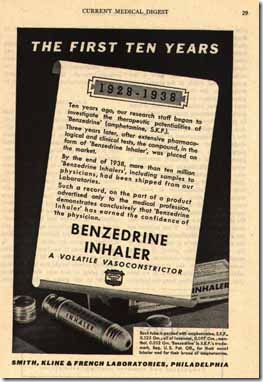
1939benzedrine
Amphetamine was synthesized too late to have the widespread applications enjoyed decades earlier by cocaine and the opiates. It was, however, marketed in products commonly used to relieve head congestion and asthma. Amphetamine continued to be employed as a popular prescription diet-aid into the 1970s.

benzedrine
Benzedrine (racemic amphetamine) inhalers were available over-the-counter until the early 1950s. Some airlines even gave them out to passengers to minimize discomfort when the plane was landing and taking off. The Smith, Kline, and French advertisement proudly proclaims that over 10 million Benzedrine inhalers had been shipped by 1938, only 7 years after the product's introduction. This may have even outpaced McDonald's hamburger sales during their early expansion (Remember the "over x million hamburgers sold" signs?).


Recommended reading:

Tuesday, November 18, 2008

Bolivian president, "US encouraged drug trafficking" + Cele Castillo Videos

Evo Morales

LA PAZ (AFP) — Bolivian leader Evo Morales on Thursday accused the US government of encouraging drug-trafficking as he explained his decision to banish the US Drug Enforcement Administration (DEA).

Morales, a staunch opponent of the Washington government, said the staff from the US agency had three months to prepare to leave the country, because "the DEA did not respect the police, or even the (Bolivian) armed forces."

"The worst thing is, it did not fight drug trafficking; It encouraged it," the Bolivian leader said, adding that he had "quite a bit of evidence" backing up his charges.

Presidential Minister Juan Ramon Quintana presented a series of documents and press clippings at a news conference, which he described as "object data" that had influenced Morales' decision to suspend DEA activities last week.

Quintana said Morales was ready to present the evidence to incoming US president Barack Obama "to prove the illegality, abuse and arrogance of the DEA in Bolivia."

Throughout the 1990s, the DEA in Bolivia "bribed police officers, violated human rights, covered up murders, destroyed bridges and roads," said Quintana.

Morales earlier Thursday said that after a 1986 operation in Huanchaca National Park, it was determined that the largest cocaine processing plant "was under DEA protection."

He also charged that the DEA had investigated political and union leaders opposed to neoliberal economic policies, which he said amounted to political persecution.

On Wednesday, he had accused the DEA of shooting and killing Bolivians during their anti-drug operations, including members of the coca farmers' movement.

Morales, Bolivia's first indigenous president, has served as the leader of the Bolivian coca-growers union. The coca plant, from which cocaine is derived, has many uses in traditional Andean culture.

The Bolivian leader announced last Saturday he was suspending the work of the DEA in the impoverished Andean nation, and accused it of having encouraged political unrest that killed 19 people in September.

"From today all the activities of the US DEA are suspended indefinitely," the Bolivian leader had said in the coca-growing region of Chimore, in the central province of Chapare, where he was evaluating efforts to combat drug trafficking.

The DEA has denied Morales' accusations.

US President George W. Bush, in a finding released in September, added Bolivia to a list of countries that have "failed demonstrably" in anti-drugs cooperation.


Retired-DEA agent Celerino Castillo exposes the atrocities and drug smuggling involvement of the US government.

MORE CELE CASTILLO VIDEO'S

Tuesday, October 14, 2008

2 TED Talks: Featuring Wade Davis

Wade Davis Ph.D. is a Harvard graduate and former student of Professor Richard Evans Shultes. He holds degrees in Anthropology, Biology and Ethnobotany and is also a professional writer, photographer, and filmmaker currently working with National Geographic. The feature film "Serpent and the Rainbow" was based on Davis's doctoral thesis on Haitian Voodoo Witchdoctors and the science behind zombification. He has done extensive fieldwork with Ayahuasca, Magic Mushrooms, DMT containing snuffs and other entheogens / psychotropic plant medicines. Last but not least he is dedicated conservationist who believes humanity's greatest legacy is the "ethnosphere," the cultural counterpart to the biosphere, and "the sum total of all thoughts and dreams, myths, ideas, inspirations, intuitions brought into being by the human imagination since the dawn of consciousness." He beautifully articulates the intellectual, emotional and moral reasons why it's in everyone's best interest to preserve the world's cultures.. I'm certain you will enjoy these TED talks, they are well worth your time to watch or listen to.


Download: in Mp3 Format

Wade Davis: Cultures at the far edge of the world with stunning photos and stories, National Geographic Explorer Wade Davis celebrates the extraordinary diversity of the world's indigenous cultures, which are disappearing from the planet at an alarming rate. 

You can learn more about the Kogi HERE. Also in the National Geographic story entitled "Keepers of the World"


Wade Davis serves on the councils of Ecotrust and other NGOs working to protect diversity. He also co-founded Cultures on the Edge, a quarterly online magazine designed to raise awareness of threatened communities.

Tuesday, April 29, 2008

More 2008 World Psychedelic Forum talks

2008 World Psychedelic Forum
Mp3's hosted by futureprimitive.org

Mp3 recordings from the World Psychedelic Forum held March 21 - 24, 2008 in Basel Switzerland. The forum presented a unique opportunity for experts, researchers, and interested persons from around the globe, to exchange views and hear about the latest research on the value of these remarkable substances in medicine, psychology, science, religion, culture and the arts.

COLOMBIAN "MAMA" (LENGTH: 18:50 mins. SIZE: 8.62MB) Shaman ("Mama") from the Kogi indigenous people of the Sierra Nevada de Santa Marta, Colombia.

JEREMY NARBY (LENGTH: 10:43 mins. SIZE: 4.91MB) Anthropologist and writer who spent several years living with the Ashaninca in the Peruvian Amazon cataloging indigenous uses of rainforest resources to help combat ecological destruction. Narby has written three books, as well as sponsored an expedition to the rainforest for biologists and other scientists to examine indigenous knowledge systems and the utility of Ayahuasca in gaining knowledge. Since 1989, Narby has been working as the Amazonian projects director for the Swiss NGO, Nouvelle Planete.

STANISLAV GROF (LENGTH: 42:34 mins. SIZE: 19.4MB) One of the founders of the field of transpersonal psychology and a pioneering researcher into the use of altered states of consciousness for purposes of healing, growth, and insight. Grof received the VISION 97 award granted by the Foundation of Dagmar and Vaclav Havel in Prague on October 5, 2007. He developed a form of psychotherapy called Holotropic Breathwork believed to allow access to nonordinary states of consciousness. Stanislav Grof also presented: The Roots of Human Violence at the conference.

DANIEL PINCHBECK & JOHN LASH (LENGTH: 1 hr., 4 mins. SIZE: 29.4MB) Daniel Pinchbeck is the author of Breaking Open the Head: A Psychedelic Journey into the Heart of Contemporary Shamanism and 2012: The Return of Quetzalcoatl and advocate of the use of psychedelic substances for enriching people's intellectual, psychological and spiritual beliefs through the psychedelic experience. John Lash is the author of Not in His Image and Quest for the Zodiac, co-founder and principal author of the Metahistory.org and one of the foremost exponents of the power of myth to direct and shape an individual's life, as well as history itself.

http://www.gaianbotanicals.com/