Showing posts with label cocaine. Show all posts

Monday, January 23, 2012

The Marketing of Madness: The Truth About Psychotropic Drugs

The Marketing of Madness is the definitive documentary on the psychiatric drugging industry. Here is the real story of the high income partnership between psychiatry and drug companies that has created an $80 billion psychotropic drug profit centre.

But appearances are deceiving. How valid are psychiatrists’ diagnoses – and how safe are their drugs? Digging deep beneath the corporate veneer, this three-part documentary exposes the truth behind the slick marketing schemes and scientific deceit that conceal dangerous and often deadly sales campaigns.

In this film you’ll discover that… Many of the drugs side effects may actually make your ‘mental illness’ worse. Psychiatric drugs can induce aggression or depression. Some psychotropic drugs prescribed to children are more addictive than cocaine. Psychiatric diagnoses appears to be based on dubious science. Of the 297 mental disorders contained with the Diagnostic and Statistical Manual of Mental Disorders, none can be objectively measured by pathological tests.

Mental illness symptoms within this manual are arbitrarily assigned by a subjective voting system in a psychiatric panel. It is estimated that 100 million people globally use psychotropic drugs.

The Marketing of Madness exposes the real insanity in our psychiatric ‘health care’ system: profit-driven drug marketing at the expense of human rights.

This film plunges into an industry corrupted by corporate greed and delivers a shocking warning from courageous experts who value public health over dollar.

Wednesday, December 9, 2009

Czech government defines rules of legal drug possession

image

The cabinet was today also expected to discuss artificial drugs and a permitted amount of these drugs in people's possession.

However, it postponed the debate for two weeks, the source said.

The new Penal Code, which will take effect on January 1 is designed to specify the government's directive. It contains a special provision on the growth of hemp and magic mushrooms.

The government today also approved a directive on the use of anabolics and the list of diseases that will be considered congenial, according to the criminal law.

The law distinguishes between the possession of marijuana and hashish for people's personal needs, for which they will face up to one year in prison, from the possession of other drugs for which they can receive up to two years in prison.

According to the Justice Ministry's proposal that the government did not approve today, the possession of over 15 grams of dried marijuana or over two grams of methamphetamine (pervitine), cocaine and heroin will be punishable.

The tolerated amount of drugs in people's possession is at present defined by police internal directives. No one thus knows precisely what amount is considered an amount "larger than a small amount of drug," the possession of which is punishable by the law.

If the government approves the ministry's proposal without changes in two weeks, people will be able to have four pills of ecstasy in their possession and up to five grams of hashish.

Prague - The Czech government today approved the list of hallucinogenic plants and mushrooms, including hemp, coca, mescaline cactus and magic mushrooms, and decided that people would be allowed to grow up to five pieces of such plants and keep 40 magic mushrooms at home, a CTK source said.

From ČTK

Friday, May 29, 2009

The good old days of Medicine

Marijuana, Cocaine, Morphine, Heroin, Amphetamine and even LSD were once medically accepted and offered as miracle cures up until this past century. These same substances that are now illegal and stigmatized will send anyone in the possession of them to prison. During this period numerous pharmaceutical manufacturers proudly proclaimed that their products contained these and other drugs. Below are a some interesting examples of these medicines.


Cocaine based Medicine
Cocaine was sold over-the-counter until 1914. It was widely used in tonics, toothache cures, patent medicines, and chocolate cocaine tablets. Prospective buyers were advised (in the words of the pharmaceutical company Parke-Davis) that cocaine "could make the coward brave, the silent eloquent, and render the sufferer insensitive to pain".


Cocaine toothache drops (circa 1885) were popular for children.
Not only would the medicine numb the pain, but it could also put the user in a "better" mood.


Metcalf's Coca Wine was one of a large number of cocaine-containing wines available on the market. All claimed medicinal effects, although they were undoubtedly consumed for their "recreational" value as well.


Vin Mariani (Circa 1865) was the leading Coca Wine of its time. Pope Leo XIII reportedly carried a hipflask of Vin Mariani with him.
CocaPope
His Holiness even awarded a Vatican gold medal to its creator, Angelo Mariani.


This coca wine was made by the Maltine Manufacturing Company (New York). The dosage indicated on the back of the bottle reads: "A wine glass full with, or immediately after, meals. Children in proportion."


Cocaine-containing throat lozenges (circa 1900) were "indispensable for singers, teachers, and orators." In addition to quieting a sore throat, these lozenges undoubtedly provided the "pick-me-up" to keep these professionals performing at their peak.


A paperweight advertisement for C.F. Boehringer & Soehne (Mannheim, Germany), "largest makers in the world of quinine and cocaine." This chemical manufacturer was proud of its leading position in the world's cocaine market.


Opiate based Medicine
formulations containing Opiates were probably even more widely employed than those containing cocaine. Laudanum had been in use for over two centuries, and the isolation of morphine in the early 19th century and the later development of heroin were lauded as even more effective remedies.

Modern authors usually suggest that widespread opium use was a major health problem during the 19th century. However, the use of opiates must be kept in proper perspective with other contemporary health problems. Mortality from cholera, malaria, and dysentery was very high, and opiates provided some relief from these illnesses (Opiates remain the most effective treatment for dysentery.). Some authors have suggested that the easy availability of opiate-based medicines saved more lives than it took. As the deleterious effects of chronic opiate use became increasingly recognized during the late 19th century, several factors helped ease the need for opiates: the improvements in sanitation diminished cholera and dysentery, the drainage of swamp lands decreased malaria, and the introduction of acetylsalicylic acid (aspirin; 1899) provided an alternative medicine for moderate pain relief.


This bottle of Stickney and Poor's paregoric (mixture of opium and alcohol) was distributed much like the spices for which the company is better known. Doses for infants, children, and adults are given on the bottle. At 46% alcohol, this product is 92 proof which is pretty potent in itself.


Bayer Heroin bottle. Up until 1910 heroin was marketed as a non-addictive morphine substitute and cough medicine for children! Heroin became it illegal to manufacture in 1924.


This ad is for Glyco-Heroin manufactured by Martin H. Smith Company (New York). Heroin was widely used not only as an analgesic but also as a remedy for asthma, coughs, and pneumonia. Mixing heroin with glycerin (and often adding sugar or spices) made the bitter-tasting opiate more palatable for oral consumption.


This National Vaporizer Vapor-OL (opium) Treatment no. 6 for asthma may have provided a unique method of essentially "smoking" opium. The volatile liquid was placed in a pan that was heated by a small kerosene lamp (see below). Other substances were also used in these early (c. 1890) vaporizers, but this mixture probably ensured plenty of visitors for the spasmodically affected.

columbus_label
Tolu & Dovers cough syrup contained Cannabis and Opium as major constituents and was manufactured by Columbus Pharmacal Co.

Drug_bottle_containing_cannbis
Above is a photo of the original Medical Marijuana, which is finally being re-accepted as part of Western Medicines Pharmacopeia. This photo shows a bottle of Cannabis Indica Fluid Extract, manufactured by American Druggists Syndicate.


Medical LSD

LSD25
Sandoz Delysid (LSD 25) D-lysergic acid diethylamide tartrate
Sugar-coated tablets containing 0.025 mg. (25 ug.)
Ampoules of 1 ml. containing 0.1 mg. for oral administration.
The solution may also be injected s.c. or i.v. The effect is identical with that of oral administration but sets in more rapidly.

INDICATIONS AND DOSAGE

a) Analytical psychotherapy, to elicit release of repressed material and provide mental relaxation, par- ticularly in anxiety states and obsessional neuroses. The initial dose is 25 ug. (1/4 of an ampoule or 1 tablet). This dose is increased at each treatment by 25 ug. until the optimum dose (usually between 50 and 200 ug.) is found. The individual treatments are best given at intervals of one week.

b) Experimental studies on the nature of psychoses: By taking Delysid himself, the psychiatrist is able to gain an insight in the world of ideas and sensations of mental patients. Delysid can also be used to induce model psychoses of short duration in normal subjects, thus facilitating studies on the pathogenesis of mental disease.

Amphetamine Containing Products
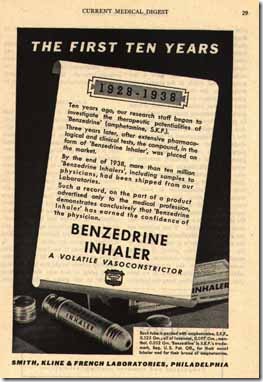
1939benzedrine
Amphetamine was synthesized too late to have the widespread applications enjoyed decades earlier by cocaine and the opiates. It was, however, marketed in products commonly used to relieve head congestion and asthma. Amphetamine continued to be employed as a popular prescription diet-aid into the 1970s.

benzedrine
Benzedrine (racemic amphetamine) inhalers were available over-the-counter until the early 1950s. Some airlines even gave them out to passengers to minimize discomfort when the plane was landing and taking off. The Smith, Kline, and French advertisement proudly proclaims that over 10 million Benzedrine inhalers had been shipped by 1938, only 7 years after the product's introduction. This may have even outpaced McDonald's hamburger sales during their early expansion (Remember the "over x million hamburgers sold" signs?).


Recommended reading:

Tuesday, November 18, 2008

Bolivian president, "US encouraged drug trafficking" + Cele Castillo Videos

Evo Morales

LA PAZ (AFP) — Bolivian leader Evo Morales on Thursday accused the US government of encouraging drug-trafficking as he explained his decision to banish the US Drug Enforcement Administration (DEA).

Morales, a staunch opponent of the Washington government, said the staff from the US agency had three months to prepare to leave the country, because "the DEA did not respect the police, or even the (Bolivian) armed forces."

"The worst thing is, it did not fight drug trafficking; It encouraged it," the Bolivian leader said, adding that he had "quite a bit of evidence" backing up his charges.

Presidential Minister Juan Ramon Quintana presented a series of documents and press clippings at a news conference, which he described as "object data" that had influenced Morales' decision to suspend DEA activities last week.

Quintana said Morales was ready to present the evidence to incoming US president Barack Obama "to prove the illegality, abuse and arrogance of the DEA in Bolivia."

Throughout the 1990s, the DEA in Bolivia "bribed police officers, violated human rights, covered up murders, destroyed bridges and roads," said Quintana.

Morales earlier Thursday said that after a 1986 operation in Huanchaca National Park, it was determined that the largest cocaine processing plant "was under DEA protection."

He also charged that the DEA had investigated political and union leaders opposed to neoliberal economic policies, which he said amounted to political persecution.

On Wednesday, he had accused the DEA of shooting and killing Bolivians during their anti-drug operations, including members of the coca farmers' movement.

Morales, Bolivia's first indigenous president, has served as the leader of the Bolivian coca-growers union. The coca plant, from which cocaine is derived, has many uses in traditional Andean culture.

The Bolivian leader announced last Saturday he was suspending the work of the DEA in the impoverished Andean nation, and accused it of having encouraged political unrest that killed 19 people in September.

"From today all the activities of the US DEA are suspended indefinitely," the Bolivian leader had said in the coca-growing region of Chimore, in the central province of Chapare, where he was evaluating efforts to combat drug trafficking.

The DEA has denied Morales' accusations.

US President George W. Bush, in a finding released in September, added Bolivia to a list of countries that have "failed demonstrably" in anti-drugs cooperation.


Retired-DEA agent Celerino Castillo exposes the atrocities and drug smuggling involvement of the US government.

MORE CELE CASTILLO VIDEO'S

Sunday, December 9, 2007

The Legal aspects for importation of Coca Leaf & Coca-Cola

The Stepan Company (a $400 million American Stock Exchange company) of Maywood, New Jersey imports 175,000 KG of coca leaves into the United States each year. The leaves come from some of the same farms that supply the Columbian drug cartels. Its finished products end up into nearly everyone in the United States.

The beverage was named Coca-Cola because, originally, the stimulant mixed in the beverage was coca leaves from South America, which the drug cocaine is derived from. In addition, the drink was flavored using kola nuts, also acting as the beverage's source of caffeine. The recipe once called for five ounces of coca leaf per gallon of syrup, a significant dose. Coca-Cola did once contain an estimated nine milligrams of cocaine per glass.

Coke dropped cocaine from its recipe around 1900, but the secret formula still calls for a cocaine-free coca extract. Today Coca-Cola includes a coca leaf extract prepared by a Stepan Company plant in Maywood, New Jersey. The facility, which had been known as the Maywood Chemical Works, was purchased by Stepan in 1959. The plant is the only commercial entity in the country authorized by the Drug Enforcement Agency to import coca leaves, which come primarily from Peru. The non-narcotic extract is sold to Coke.

The cocaine is then sold and delivered in armored trucks to Mallinckrodt Inc., a St. Louis pharmaceutical manufacturer that is the only company in the United States licensed to purify the product for medicinal use. There cocaine containing products are manufactured and sold to the medical industry.

The other major product is the coca in Coca-Cola©. The Coke formula is one of the most closely guarded corporate secrets in America. The company concedes to using a 'decocainized flavor essence in the coca leaves'-one of the few Coke ingredients the company will publicly acknowledge. When asked why the company uses such a troublesome product as coca leaves, its representative said that 'each ingredient adds to the flavor profile.'

Flavor scientists say that the mysterious essence has no significant taste of its own , but acts as an 'enhancer' PepsiCo Inc. does not use the coca leaf. Flavor scientist Nicholas Feurstein thinks that the average guzzler might well notice the difference if Coke stopped using it. ..

The very first batch of Coca-Cola contained an extract of coca leaves back in 1886. Coke had in fact contained traces of cocaine ever since John 'Doc' Pemberton created the drink. At the turn of the century, a public outcry erupted against cocaine. Doctors and editorialists began taking aim at Coca-Cola.

Now the company had a catch-22 problem. If it removed the coca leaf from the product's manufacture, it could no longer defend use of the name. If cocaine was used, an angry public would boycott Coca-Cola. An elaborate extraction process was devised.

The leaf is ground up, mixed with sawdust, soaked in bicarbonate of soda, percolated with toluene, steam blasted, mixed with powdered Kola nuts, and then pasteurized. The Coke-Cola company, forever fearful of the DEA and the drug lords, is a stickler on security and quality. Drug lords have a less formal way to extract cocaine: they use kerosene as a solvent; the drug leaches out like tea from a tea bag. Cocaine is then recovered by evaporation.

The Coca-Cola company itself is extremely squeamish about the subject of coca leaves. A 1948 one-paragraph reference to the Maywood's production of coca extract so enraged top Coke officials that they threatened to slash all Wall Street Journal advertising in retaliation. An internal Coke memo, unearthed by historian Frederick Allen blasted the Wall Street Journal s 'an instrument of the chiselers and the substituters' and suggested sending stories to the rival Journal of Commerce, 'which has not felt tempted to publish bits or pieces of our formula.'

Resource

Miller, M. "Quality Stuff: Firm is Peddling Cocaine, and Deals are legit" Wall Street Journal 27 Oct 1994.Weil, A. "Letters from the Andes The New Politics of Coca" The New Yorker May, 1995 pp7

*The information was obtained from multiple sources on the Internet

As always,please consider for all your ethnobotanical needs
www.GaianBotanicals.com